The Complete RTW Instrument Line-Up
From Loudness to Immersive Insight - All RTW Instruments in One Place.
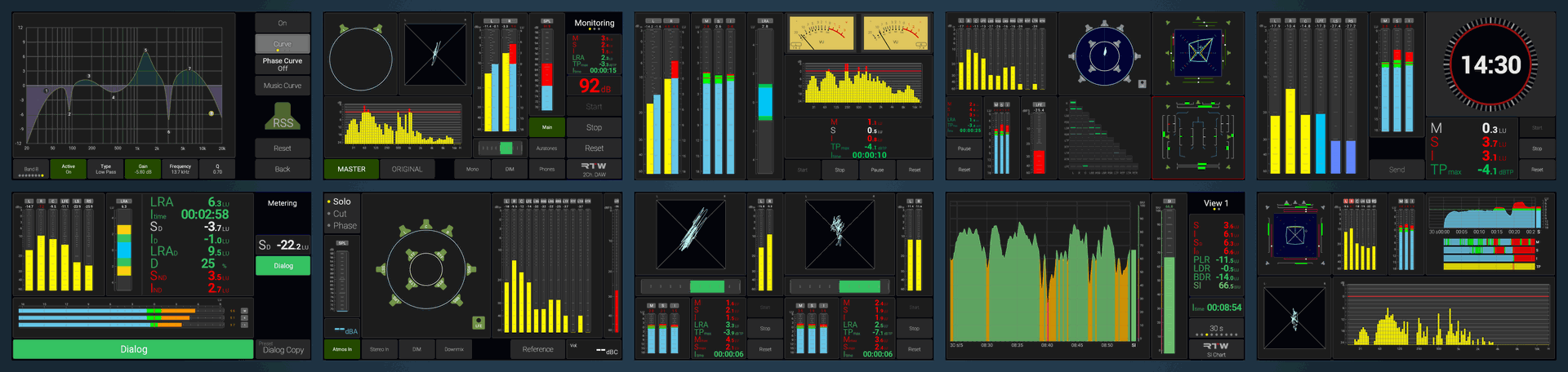
We offer a full suite of metering and analysis tools for immersive, speech-intelligent, and compliant workflows.
Level and loudness meters, stereo and phase tools, and detailed spectral analysis ensure precision at every stage. Immersive and speech-intelligibility instruments reveal balance, clarity, and listener impact. System and compliance tools keep performance and standards in check, all within one powerful platform.
Essential Tools
Precision metering never goes out of style.
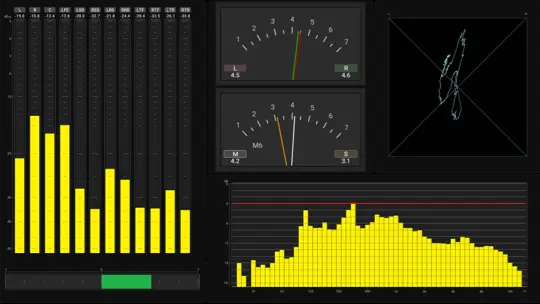
RTW’s classic instruments provide trusted visual insight into important aspects of your audio signal - from levels to phase and frequency balance.
PPM Metering: Comprehensive. Accurate. Trusted
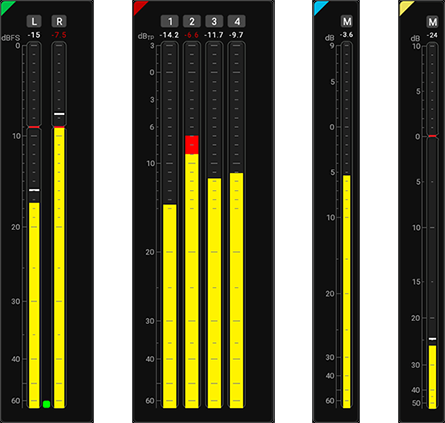
TouchControl 5 features a fully equipped PPM meter for precise and reliable measurement of any network audio channel.
TouchControl 5 supports all standard professional scale types, ensuring compatibility with any production environment.
Additional features such as a switchable peak-hold indicator, peak memory, and over indicator enhance metering accuracy and workflow efficiency.
A correlation meter placed between the stereo bargraphs further assists in detecting and addressing stereo phase or correlation issues.
TP20: +3..-30 dB
Dig60: 0..-60 dB
Dig40: +20..-40 dB
Dig20: 0..-20 dB
Dig0: 18..0 dB
Dig18: +18..-18 dB
ARD9: +9..-60 dB
DIN5, +5..-50 dB
DIN10: +10..-50 dB
Nordic: +12..-42 dB
BRIIa: 7..1
BRIIb: -12..+12
BRIIa ext: 7..1
BRIIb ext: -12..+12 dB
ZOOM1: +1..-1 dB
ZOOM10: +10..-10 dB
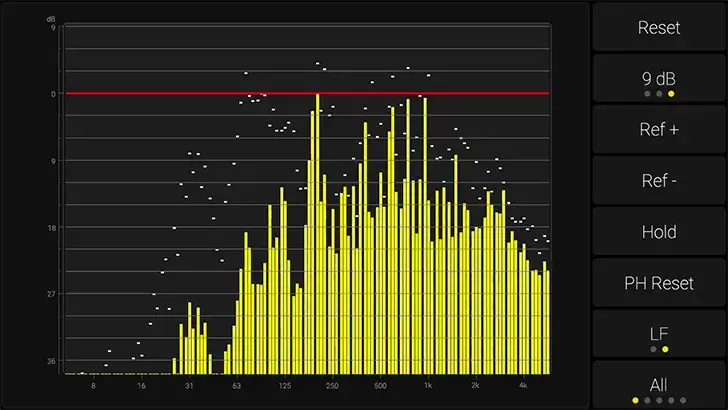
The Real Time Analyzer
Visualize the energy distribution of your audio with precision and clarity.
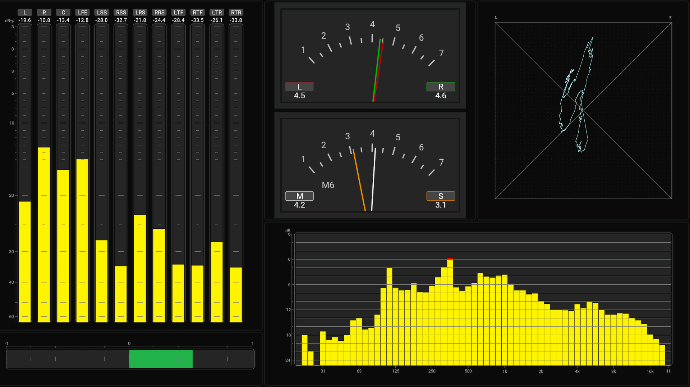
The RTA works with any speaker format and offers flexible octave resolutions, customizable layouts, and enhanced color visualization.
With zoomable low-frequency analysis, high-band display, and multiple filter options, it’s the ideal tool for accurate monitoring in music, broadcast, and post-production.
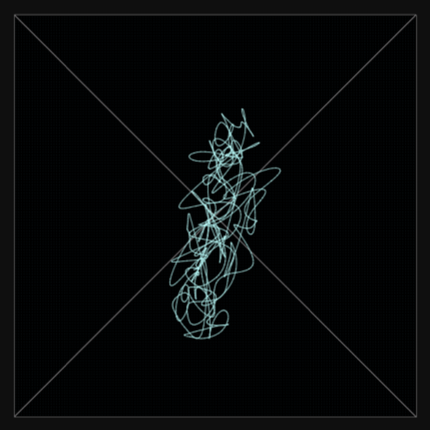
Audio Vectorscope
The 2-Channel Audio Vectorscope uses a Lissajous display to visualize the phase relationship between two stereo channels in real time. It quickly reveals stereo width, balance, and phase issues such as shifts, rotations, or cancellations.
Widely used in mixing, mastering, and broadcast, the Vectorscope is an essential tool for ensuring proper stereo imaging, phase alignment, and mono compatibility.
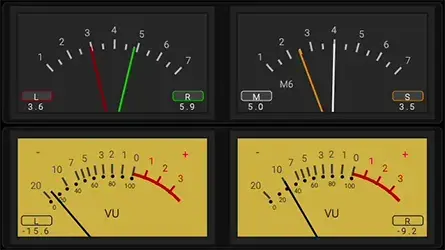
The Moving Coil
The Moving Coil instrument brings classic metering precision to your screen, available in 2-channel stereo mode.
Choose between PPM (British) or VU displays: single or combined, vertical or horizontal - and tailor it to your workflow.
For added flexibility, Loudness scales and a combined PPM + Loudness view (BBC mode) are also available.
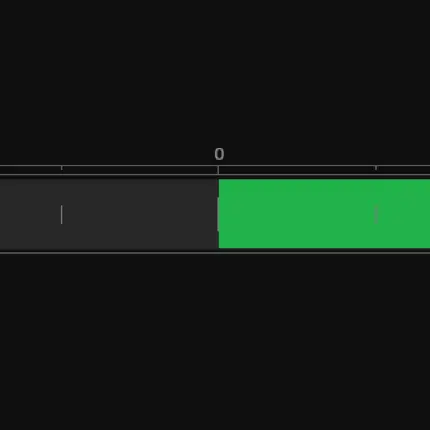
The Stereo Correlator
Phase & Imaging: Visualized with Precision
The Stereo Correlator visualizes the phase relationship between the two channels of a stereo signal, providing quick insight into stereo compatibility.
Essential in mixing, mastering, and broadcast, the Stereo Correlator helps engineers maintain consistent sound quality and ensure reliable mono compatibility.
Loudness,
Loudness,
Loudness
For many years, RTW has taken part of forming the international loudness standards in ITU and EBU. Loudness is key to us, so in TouchControl 5 we have implemented the full loudness engine known from our high end broadcast meters.
TouchControl 5 supports all international loudness standards such as EBU R128, ITU-R BS.1770-4/1771-1, ATSC A/85, ARIB, OP-59, AGCOM, CALM, LEQ(M), TASA and SAWA.
On top of the ITU/EBU loudness standards, you’ll find support for Dialog Gated Loudness Measurement, enabling compliance with dialog-based specifications, which are aligned with Netflix delivery standards.
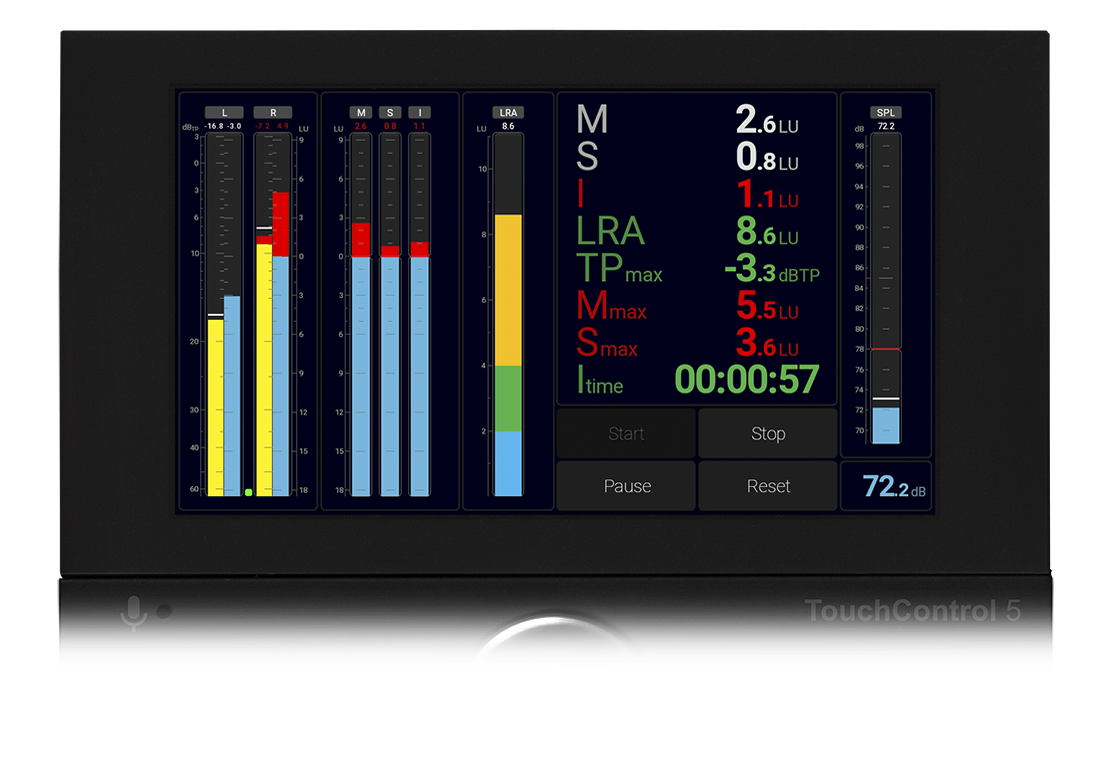
Chart
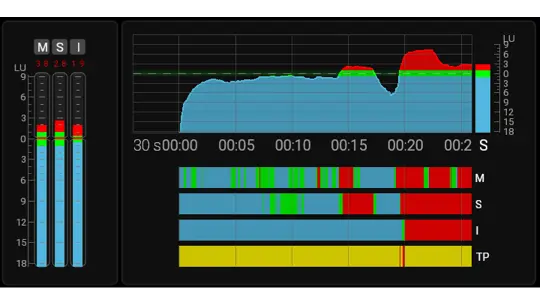
The Chart provides a clear visual timeline of loudness or speech intelligibility, making it easy to monitor dynamics and consistency in broadcast, streaming, or post-production.
It can display Momentary, Short-Term, Integrated, and True-Peak Loudness, as well as Speech Intelligibility over time, giving insight into both transient details and long-term trends.
With a flexible time range from 10 seconds to 2 hours, auto-scaling, and customizable appearance, the Chart adapts to any workflow. It can also synchronize with other meters for a complete overview.
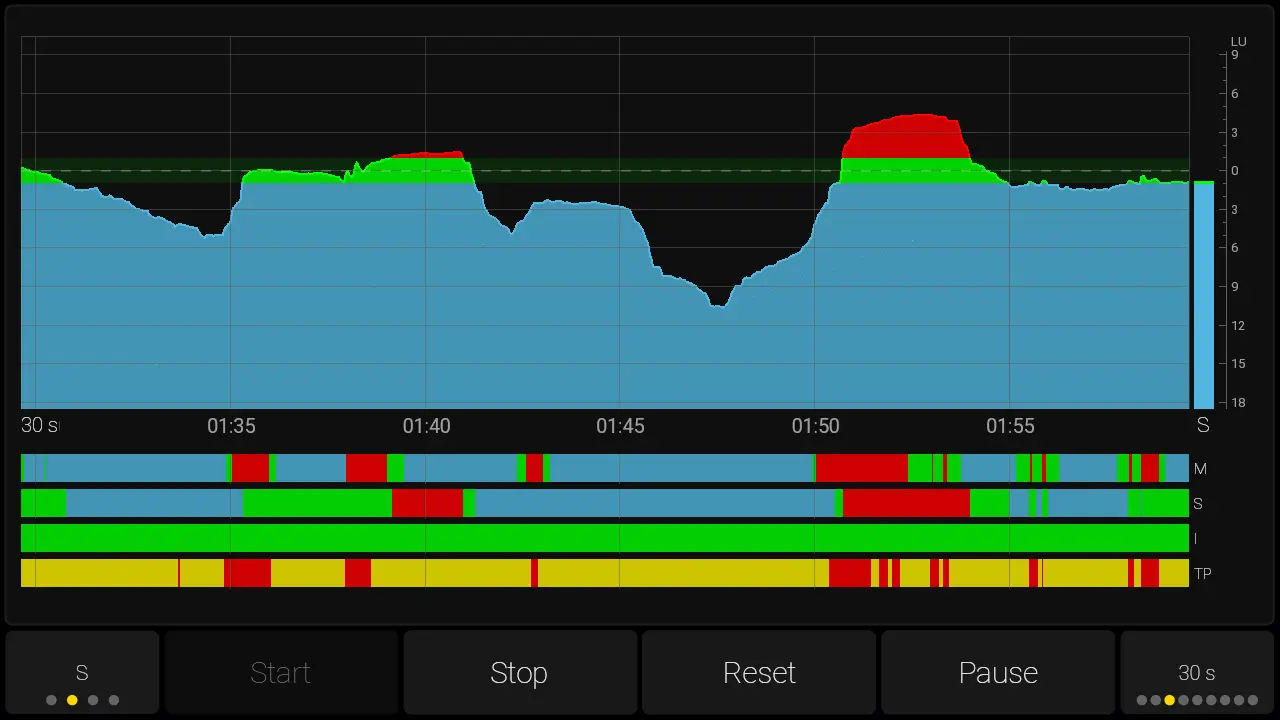
Loudness Summation
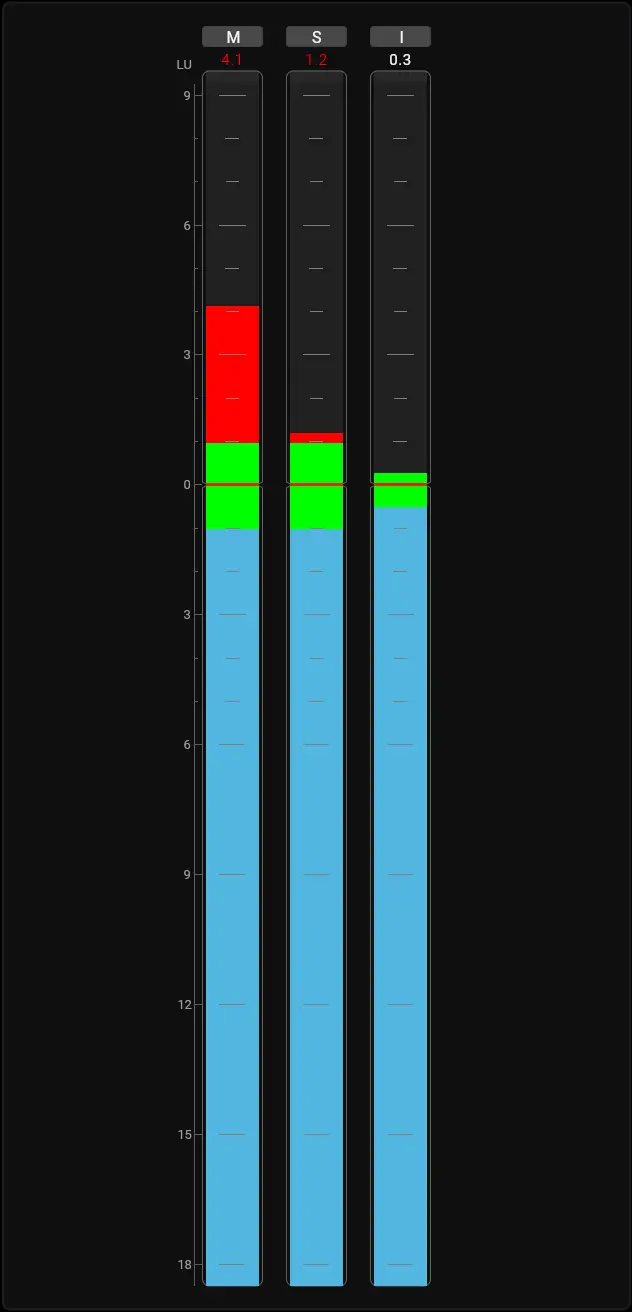
The Loudness Summation instrument displays a bargraph of summed loudness values:
Momentary (M)
Short-term (S)
Integrated (I)
It can also show dialog-gated measurements:
- Momentary Dialog-gated (MD)
- Short-term Dialog-gated (SD)
- Integrated Dialog-gated (ID).
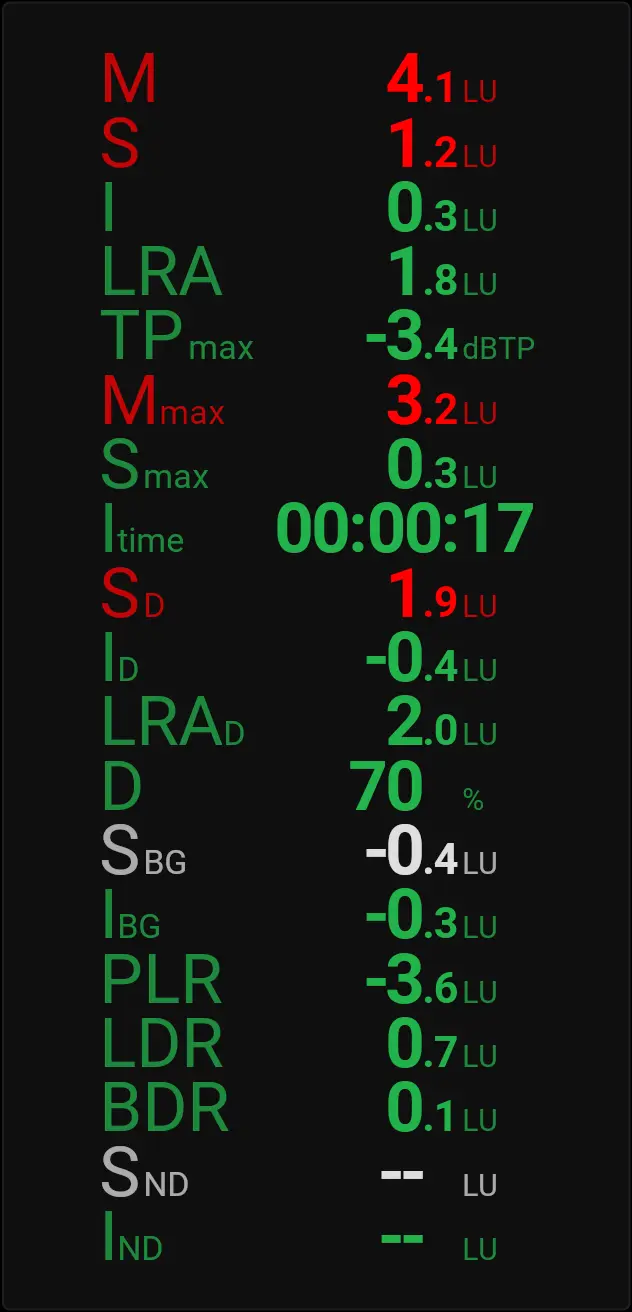
The Numeric Instrument
Numbers tell the story of your mix.
With the Numeric Instrument, you get a clear, detailed view of all key loudness and level parameters, including Momentary, Short-term, Integrated Loudness, True-Peak Max, and much, much more.
It’s the precision tool for engineers who want instant, reliable loudness insight, from broadcast compliance to creative mixing.

Loudness Range
The LRA (Loudness Range) instrument displays a graphical representation of the loudness variances within short time periods.
These are measured against the Loudness Range (LRA) descriptor specified in EBU R 128. It is used to show whether a program has a continuously constant loudness or a high variation between low and high level components.
It allows for making assumptions on whether the program has seen or requires dynamic processing with regard to the intended distribution path.
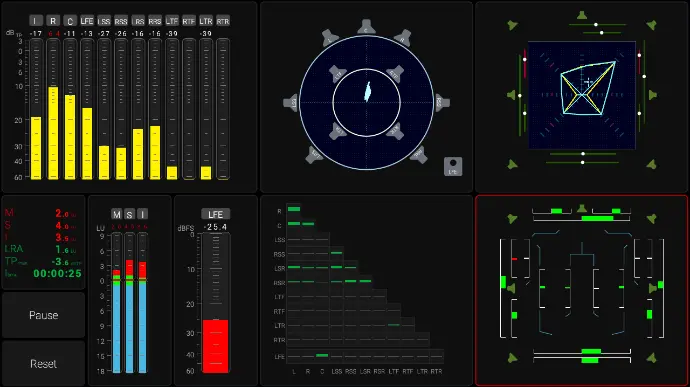
Immersive Measuring
The analysis of surround and immersive audio requires tools that not only measure but also visualize spatial relationships in a way that reflects what we actually hear.
RTW’s suite of immersive metering instruments brings this capability to life, giving sound engineers immediate insight into the spatial balance, phase relationships, and overall integrity of their mixes. They are available as a license option.
The Immersive Sound Analyzer

The Immersive Sound Analyzer visualizes the relationships between channels within up to two layers. It supports channel formats for both surround (e.g., 5.1) and immersive audio, such as Atmos 7.1.4.
Its graphical display is designed so that the dynamic behavior of all elements corresponds to the subjective listening impression, allowing the balance of a surround or immersive program to be monitored intuitively at a glance.
The Dominance Indicator (white cross) further shows the position of the subjectively perceived acoustic focal point.
With the Immersive Sound Analyzer you can:
- Monitor the overall spatial balance of the surround- or immersive image
- Measure total loudness within layers
- Monitor the relationship between the layers
- Identify phase issues to ensure correct downmixing
- Evaluate stereo width and perceived position between channel pairs
- Detect correlation problems in the LFE channel

Matrix Correlator
The Matrix Correlator displays phase relationships between all channels, supporting formats from stereo up to 22.2.
It provides a complete overview of inter-channel correlations, making it easy to detect potential phase issues within a mix.
Multi Correlator
The Multi Correlator is a valuable tool for working with surround or immersive sound, ensuring that a surround mix will also translate correctly when downmixed to stereo or even mono.
It provides a clear, single-view display of the phase relationships between all channels.
Polarscope


Inspired by the classic vectorscope, the Polarscope introduces a new algorithm that visualizes inter-channel correlations using a spatially aware coordinate system. Each loudspeaker position is represented as a vector in space, and signal levels are combined to generate real-time geometric shapes on the display.
In a traditional stereo vectorscope, identical channel content appears as a vertical line, while polarity inversion creates a horizontal line. The Polarscope extends this principle to surround and immersive layouts, where signal interactions form unique geometric patterns that reveal spatial attributes such as:
Dynamic Development of Spatiality (Image width and depth)
Front/rear energy balance
Channel delay mismatches
Phase issues or mirror symmetry
The Polarscope algorithm was presented by our software developer Pavel Smokotnin at the 158th AES Convention (2025 Warshaw).

LFE Bleed
It is essential to ensure that no high-frequency content is present in the LFE channel, as this can cause severe playback issues with certain encoders, including binaural formats.
As a general recommendation, the LFE frequency range should be limited to avoid problem during distribution.
The LFE Bleed Instrument measures energy above a certain frequency (120 Hz by default) and displays a momentary loudness value on a dBFS scale in a compact bargraph.
Any visible activity signifies unwanted content leaking into the LFE channel.
Dialog Intelligibility
Monitoring speech intelligibility is essential to ensure that dialogue remains clear, consistent, and easy to understand across all platforms and listening environments.
- Keep audiences engaged - unclear dialogue causes frustration and loss of attention
- Ensure consistency across playback systems and listening environments
- Save time by revealing masking issues early in the mix
- Improve accessibility and overall listening comfort
Dialog Gated Loudness Measurement
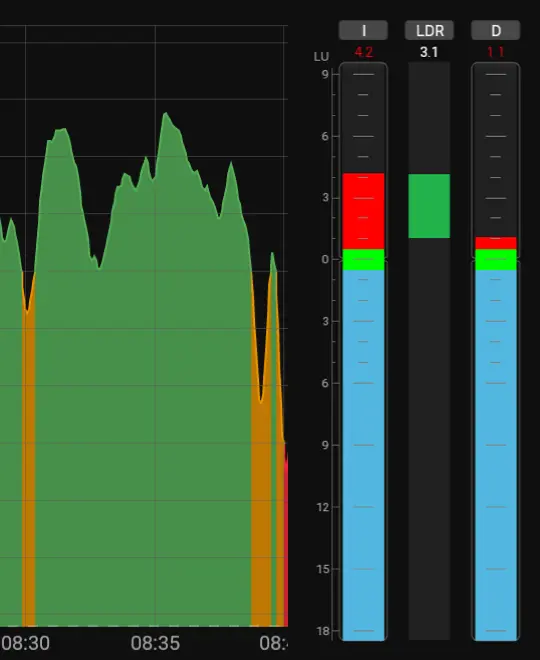
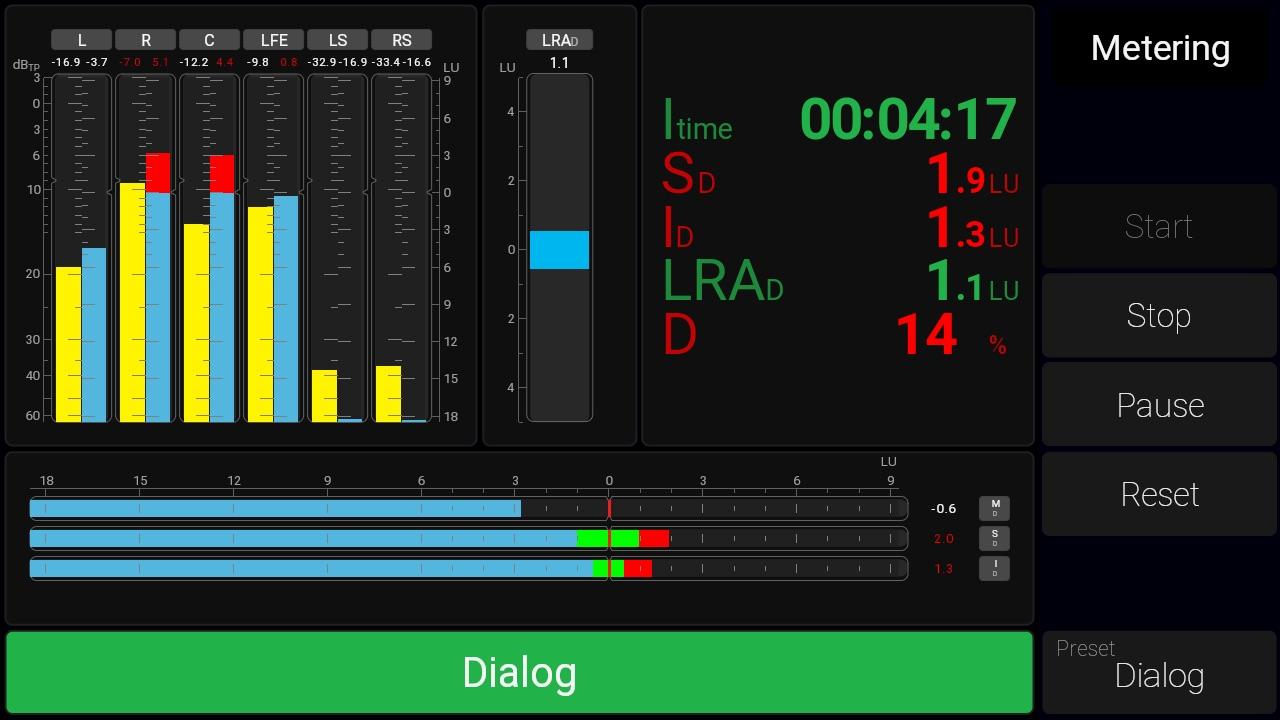
Dialog-gated measurements ensure compliance with dialog-based specifications that for example adhere to Netflix delivery standards.
The Loudness Number instrument provides metrics such as ID (Dialog-Based Integrated), SD (Dialog-Based Short-Time), and D (Dialog Content Percentage).
The LRA instrument displays the Dialog-Gated Loudness Range, while the Dialog Detector identifies when dialog is present. This detector can be resized, ranging from a small overlay to covering the entire screen.
The Ratio Instrument
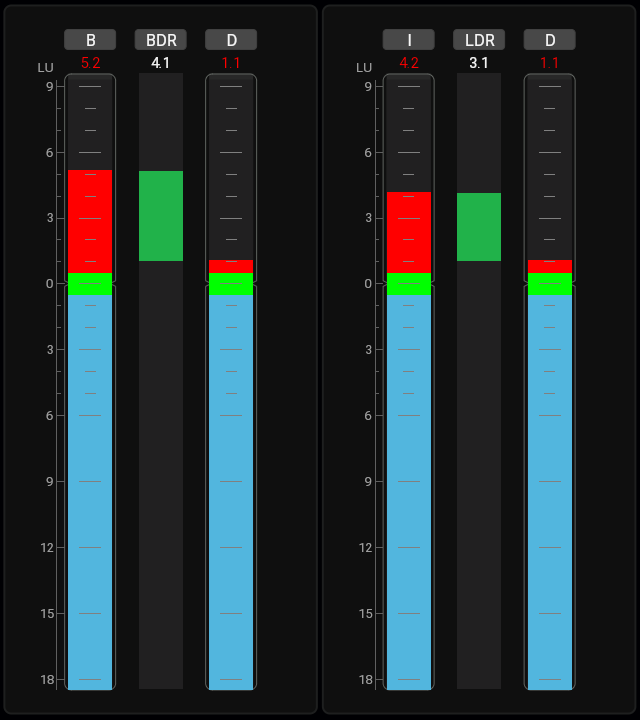
The Ratio Instrument displays the difference, or ratio, between two loudness measurements.
It is particularly useful for monitoring ratios within one audio source:
- Loudness-to-Dialog Ratio (LDR)
- Background-to-Dialog Ratio (BDR)
Or between two different sources:
- Compare loudness before and after processing
- Compare loudness of different rendered layouts (immersive vs stereo, mono downmix etc.)
All in all, the Ratio Instrument offers a flexible way to evaluate balance, consistency, and the impact of processing across a wide range of production scenarios.
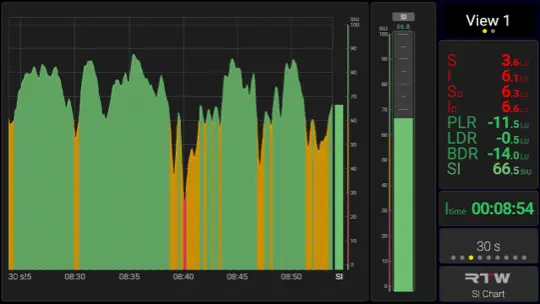
The Speech Intelligibility Meter
The Speech Intelligibility (SI) Meter for TMxCore is designed to help broadcasters and professional audio engineers tackle one of the most critical challenges in production: keeping dialogue clear and intelligible.
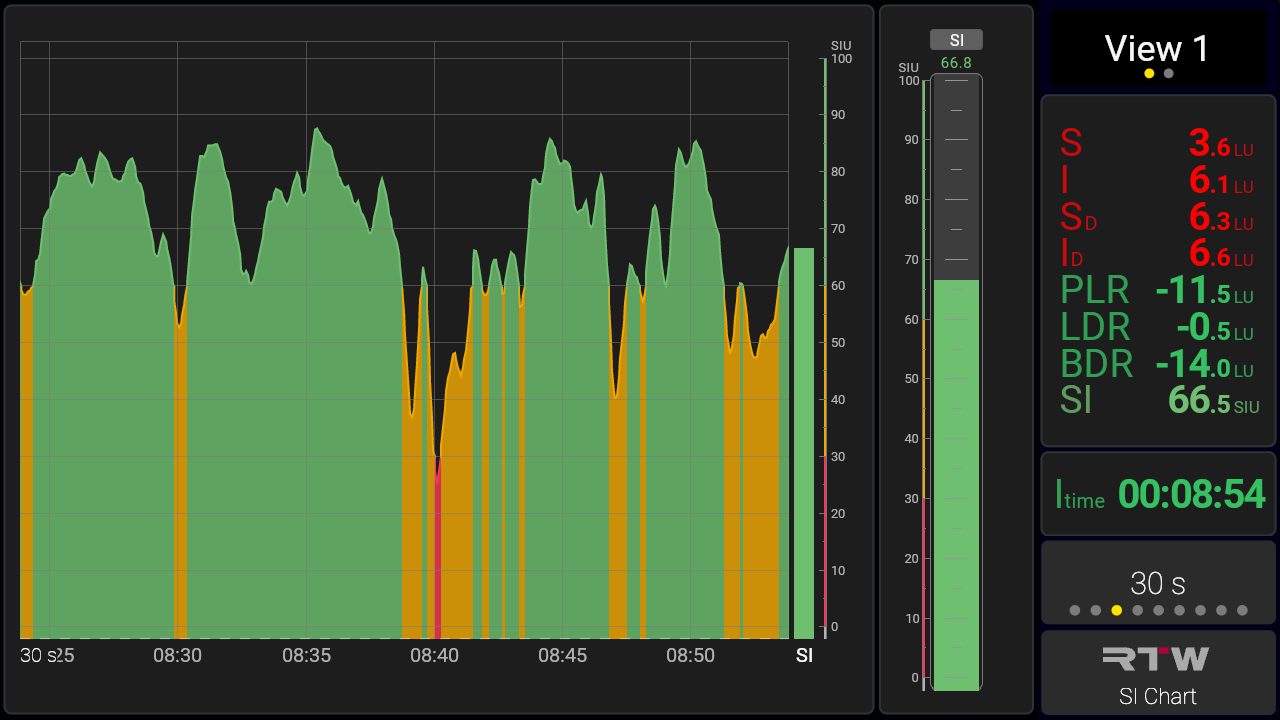
AI-driven, objective measurement of dialogue clarity
Developed in close cooperation with Fraunhofer IDMT, the SI Meter uses advanced AI-based algorithms to provide an objective, real-time measurement of how well speech can be understood in a mix. Instead of relying on subjective impressions, engineers get clear visual feedback that guides them in balancing dialogue, effects, music, and background sounds.
This collaboration builds on more than nine years of joint research, beginning with the SI4B (Speech Intelligibility for Broadcasting) project, and has since evolved into a robust solution now available within RTW’s TMxCore platform.
Why it matters
Whether it’s:
Unclear dialogue in a drama series
Background music masking voices in reality TV
Crowd noise overwhelming commentators in live sports
Dialogue clarity issues in streaming and on-demand content
… the SI Meter gives engineers the tools to deliver consistent speech clarity across all formats.
Key benefits
Objective results - AI-powered analysis replaces guesswork
- Real-time feedback – instantly see how dialogue is perceived
- Easy-to-use interface – intuitive visual display within TMxCore
- Broad applications – ideal for broadcast, post-production, streaming, and live events
- Developed in close cooperation with Fraunhofer IDMT
Built for TMxCore
The Speech Intelligibility Meter is available as a license option for TMxCore, RTW’s next-generation metering platform built on the legacy of the classic TouchMonitor series.
Tools
Take control of your entire audio network - directly from your RTW.
From precision level adjustment with the Fader instrument to customizable workflows powered by the Action Instrument and OSC, you can monitor, mix, and command with unmatched flexibility.

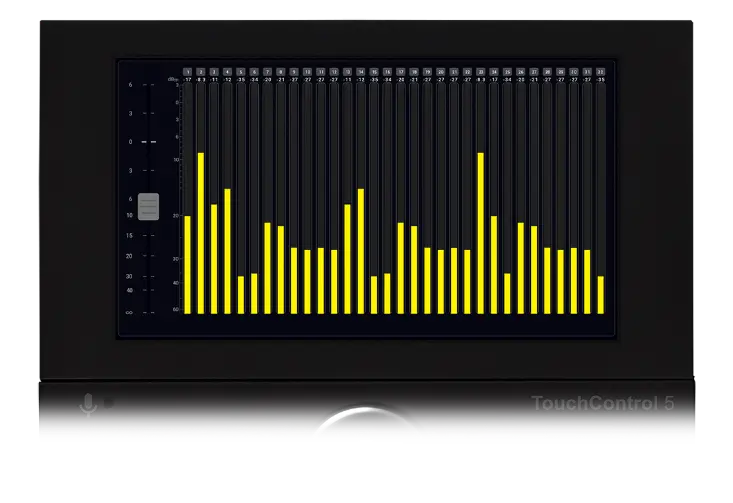
Network Level Control
The Fader instrument allows level control of any channel in your network, and you can freely configure each fader to control the number of channels you wish. More faders can be combined, so you can control multiple groups of channels, and if you do so, levels are controlled relatively, using TouchControl 5's knob.
TouchControl 5's touch screen can of course also be used to control each fader, and you can create up to 4 faders each controlling single channels, stereo-, surround- or immersive formats.
Toolbox instruments also include a Talkback feature that lets you talk to any audio channel in you network. Talkback sources include the built-in mic, the external XLR input or any audio network channels.

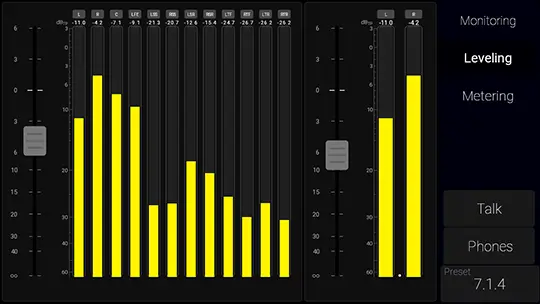
Faders can be based on any of the support channel formats. Here you see a 7.1.4 and a stereo.
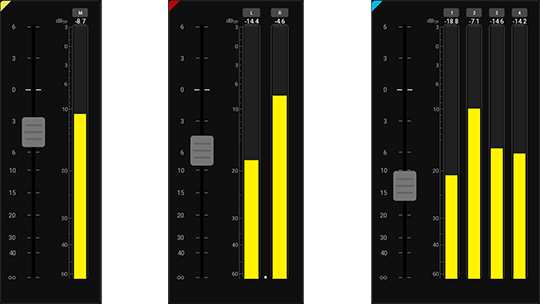
Examples of different fader groups: mono, stereo or 4-channel. These can be expanded to 32 channels.
Action Instrument & Open Sound Control
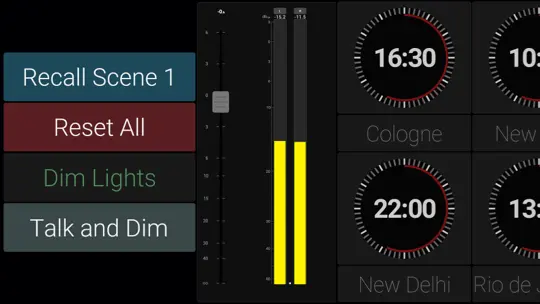
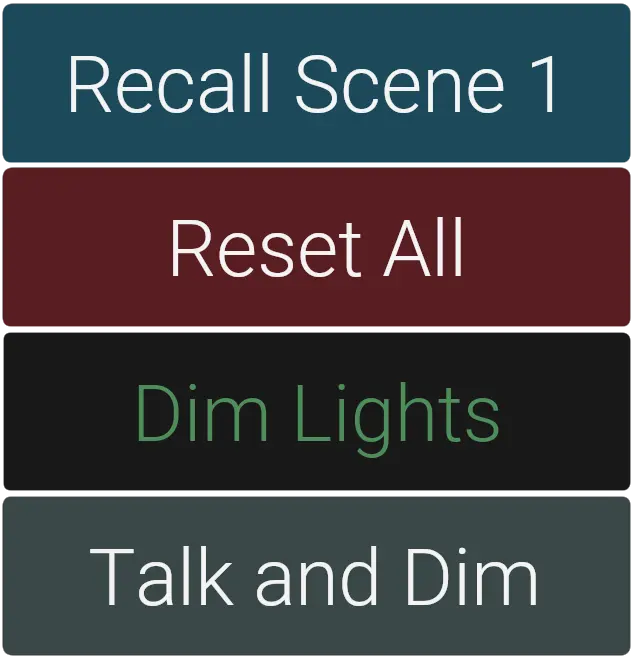
The Action Instrument & OSC adds powerful control capabilities directly into your metering environment.
It lets users create fully customizable buttons and assign specific actions, while also extending TouchControl 5 with full Open Sound Control (OSC) support.
- Customizable Buttons – design buttons with complete control over size, position, and color.
- Flexible Protocol Support – trigger commands via Open Sound Control (OSC) over TCP/UDP, or send HTTP requests.
- Two-Way OSC Integration – TouchControl 5 and TouchMonitor not only send commands but also respond to incoming OSC, enabling control of key functions such as preset recall, loudness start/stop/reset, reference level recall, mic gain adjustment, and more.
- Seamless Workflow Integration – connect directly to mixers, automation systems, and external devices to streamline production workflows.
- Actions are also available in all current buttons. So, when you hit MUTE, you can send an action at the same time.
With Action Instrument & OSC, your device evolves from a pure metering solution into a fully interactive, customizable control hub.
Learn more about OSC and get the full implementation specification
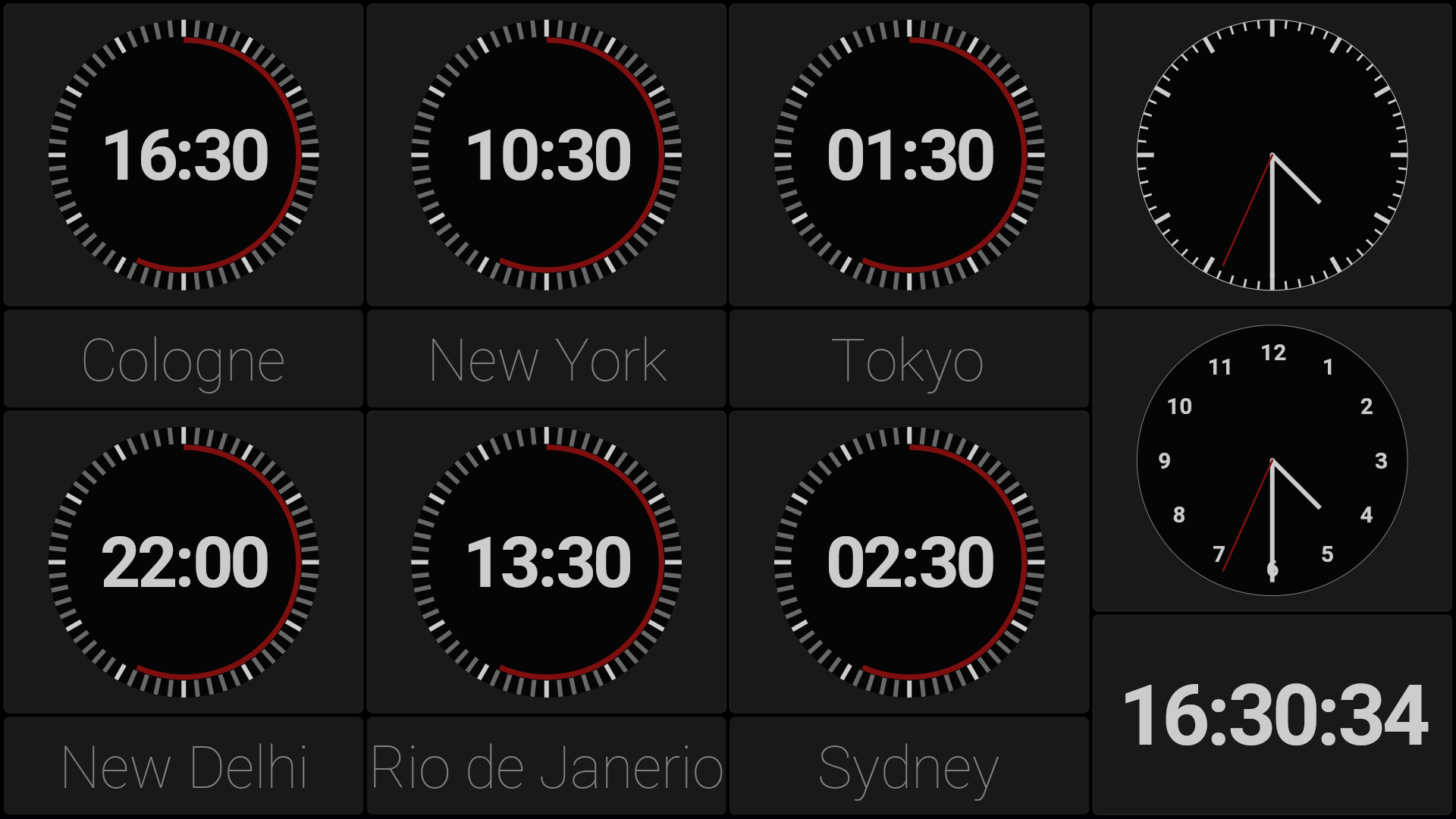
The Clock Instrument: Timekeeping Built for Broadcasters
The Clock Instrument integrates reliable timekeeping into your metering setup with a broadcaster-friendly design.
It supports multiple time zones, making it easy to reference both local and remote production times within the same workflow.
With flexible display options, time zone support and a broadcaster-friendly design, the Clock Instrument makes accurate wall-clock reference an integral part of your monitoring workflow.

Delay Compensation
With the introduction of dialog-gated loudness measurement, some instruments may introduce significant delay - up to 2 seconds in certain cases. This is necessary, as the algorithm requires time to reliably detect whether the audio contains dialogue.
While such latency is not ideal, RTW’s metering engine includes built-in delay compensation, and in addition, all metering instruments provide audio outputs.
Delay compensation ensures that:
- All meters are aligned visually
- All audio outputs remain time-aligned, so playback corresponds precisely with the display.
Delay compensation is typically only relevant if you work with Dialog Gated measuring (Loudness Type = Dialog Gated or Netflix).